Apps & Tools
Best Mood Tracking Apps (2026)
The best mood tracking apps for 2026, compared. Free daily mood logging, journal-style options, CBT tools, and mood trackers that connect how you feel to sleep, cycles, and symptoms.


Shivay Madan, Co-Founder & CMO at Rox
Updated
Mood on its own is hard to read. Add sleep, cycles, medications, and how much you did yesterday, and the picture gets clearer. The right mood tracker turns a day’s feelings into a pattern you can actually act on.
A mood tracking app is a mobile tool that lets you log how you’re feeling over time and see the patterns between mood and everything else in your life. Here are the best for 2026, from the fastest daily loggers to journal-style apps and mood-plus-health trackers.
What to look for
Fast daily logging you can actually keep up with
Meaningful patterns without needing a paid tier just to see them
Extra context if you want it: sleep, activity, medications, cycle
Privacy — mood data is personal, know where it goes
The best mood tracker apps at a glance
Rox is made by our team; the rest of this comparison is independent research. Prices checked July 2026.
App | Best for | Cost |
|---|---|---|
Daylio | Fast, minimal daily mood logging | Free tier + paid |
Moodfit | CBT tools and mental-fitness structure | Free tier + paid |
Reflectly | AI-guided journaling and reflection | Free tier + paid |
Bearable | Mood alongside broad symptom tracking | Free tier + ~$35/yr |
Rox | Mood as part of overlapping health conditions | Free (AI optional) |
Daylio — best for fast, minimal daily logging
Daylio lets you log your mood and activities in two taps and builds up a picture over weeks. It’s built for speed and stickiness, which is why so many people keep it around when other apps fall off. Premium unlocks reminders, advanced stats, and backups.
Moodfit — best for CBT and mental fitness
Moodfit takes a more structured approach, with tools grounded in cognitive behavioral therapy and mindfulness. It won Verywell Mind’s Best Mood Tracker recognition. The free version is limited; Premium unlocks the deeper toolkit.
Reflectly — best for guided journaling
Reflectly is an AI-guided journal-plus-mood-tracker that prompts you with reflection questions and adapts to how you use it. If a blank journal is intimidating and you want something between “log a face” and “write freely,” Reflectly sits well in the middle.
Bearable — best for mood alongside symptom tracking

Bearable covers mood, energy, sleep, symptoms, medications, and custom factors, with a generous free logging tier. Deeper correlation insights sit behind Bearable Premium (~$35/year).
Rox — best for mood as part of overlapping health conditions
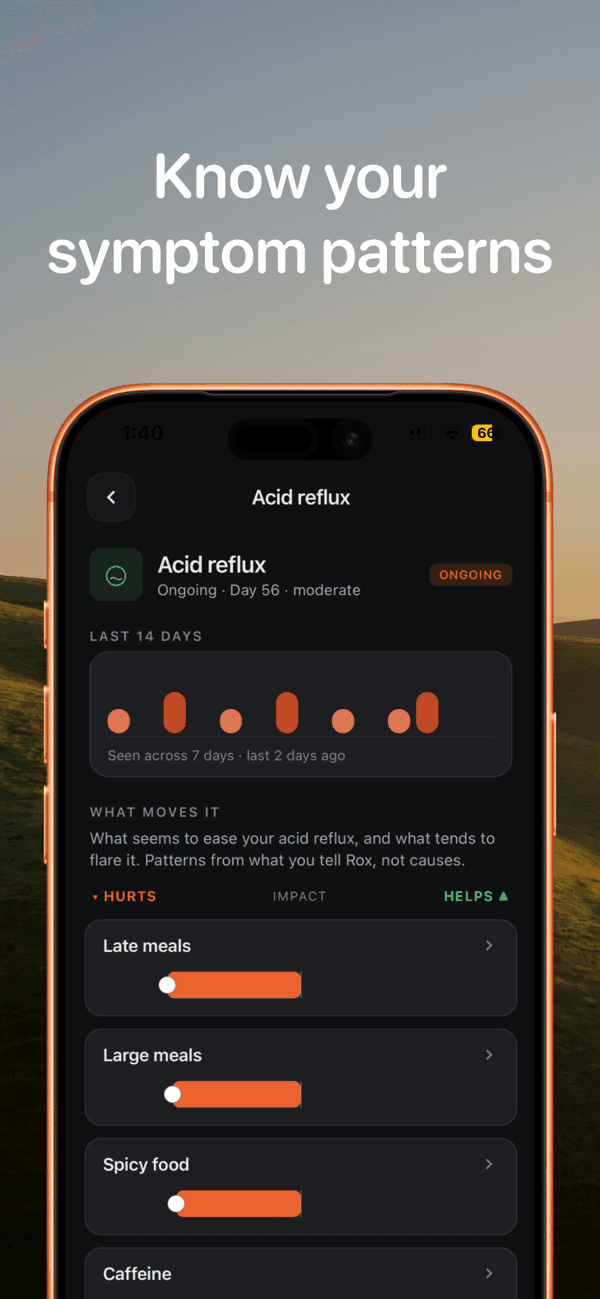
Mood rarely stands alone when a chronic condition is in the picture. Perimenopause, POTS, chronic fatigue, and pain all bend mood, and vice versa. Rox is a free tracker built for exactly this overlap: you log mood alongside symptoms, medications, hydration, and vitals, connect an Whoop, Oura, Apple Watch, or Garmin, and Rox surfaces the patterns across the whole picture. Free for logging, insights, and the report; only the AI features are paid. Try Rox on the App Store.
Which mood tracker should you choose?
Fastest daily logging: Daylio
CBT and structured mental-fitness work: Moodfit
Guided AI journaling: Reflectly
Mood plus broad symptom tracking: Bearable
Mood as part of a chronic condition: Rox
Mood is one thread in a bigger picture. If you’re logging several diagnoses at once, a symptom tracker for multiple conditions keeps them in one place instead of three apps.
What makes a good mood tracking app?
The best mood tracking apps share three things. Logging has to be fast enough that you’ll still do it on a bad day, which usually means a few taps rather than a form. The app has to show you patterns rather than just storing entries, so you can see what actually moves your mood. And it should let you track something alongside mood, whether that’s sleep, medication, your cycle, or symptoms, because mood on its own rarely explains itself.
Where mood tracking apps split is depth. A minimal tracker like Daylio is built for speed and streaks. A mood tracker built for health, like Bearable or Rox, is built to connect mood to everything else going on in your body. Neither is better; they answer different questions.
Frequently asked questions
What is the best free mood tracker app?
Daylio’s free tier is the best pure mood-logging experience. Bearable and Rox are free for tracking mood alongside symptoms, sleep, and medications.
Which mood tracker is best if I have a chronic illness?
Bearable and Rox both let you track mood in the context of symptoms, sleep, cycle, and medications, so you can see what’s actually driving how you feel.
Do mood tracker apps replace therapy?
No. They can help you and your therapist see patterns and time treatment, but they’re a tool, not a substitute for care.
Is my mood data private?
It depends on the app. Check each app’s privacy policy before you commit to logging sensitive information.
Track it yourself: the free mood tracker, symptom tracker and sleep tracker all run in your browser with no sign-up, and your data stays on your device. See all chronic illness trackers.