Apps & Tools
Best Bearable Alternative
Rox vs Bearable, compared honestly. Both are great symptom trackers, but the insights and doctor report Bearable puts behind a paywall are free in Rox.


Shivay Madan, Co-Founder & CMO at Rox
Updated
If you track a chronic condition, you’ve probably come across Bearable. It’s a genuinely good app, and one of the most popular symptom trackers out there. So where does Rox fit, and which one is right for you?
The short version: both let you log symptoms, medications, and factors for free. The real difference is what happens with that data. Bearable puts its deeper insights and correlations behind a paid subscription. Rox gives you the insights and a doctor-ready report for free, and only charges for its AI features.
Rox vs Bearable at a glance
Rox is made by our team; the rest of this comparison is independent research. Prices checked July 2026.
Rox | Bearable | |
|---|---|---|
Symptom & factor logging | Free | Free |
Medication logging & reminders | Free | Free |
Health vitals | Free | Free |
Insights & correlations | Free | Premium (about $35/year) |
Doctor-ready report | Free | Data export; deeper insights are Premium |
Wearable data | Free | Imports some from Apple Health / Fitbit |
AI companion | Paid add-on | Not available |
Best for | Complex, overlapping conditions | Broad mood and symptom tracking |
Where Bearable is strong
Credit where it’s due. Bearable is flexible, well designed, and covers a huge range of things to track: mood, energy, sleep, symptoms, medications, and custom factors. Its free tier is generous for logging, and it has a large, loyal community. If you mainly want a customizable daily tracker and you’re happy to pay around $35 a year for the deeper correlation analysis, Bearable is a solid choice.
Where Rox is different
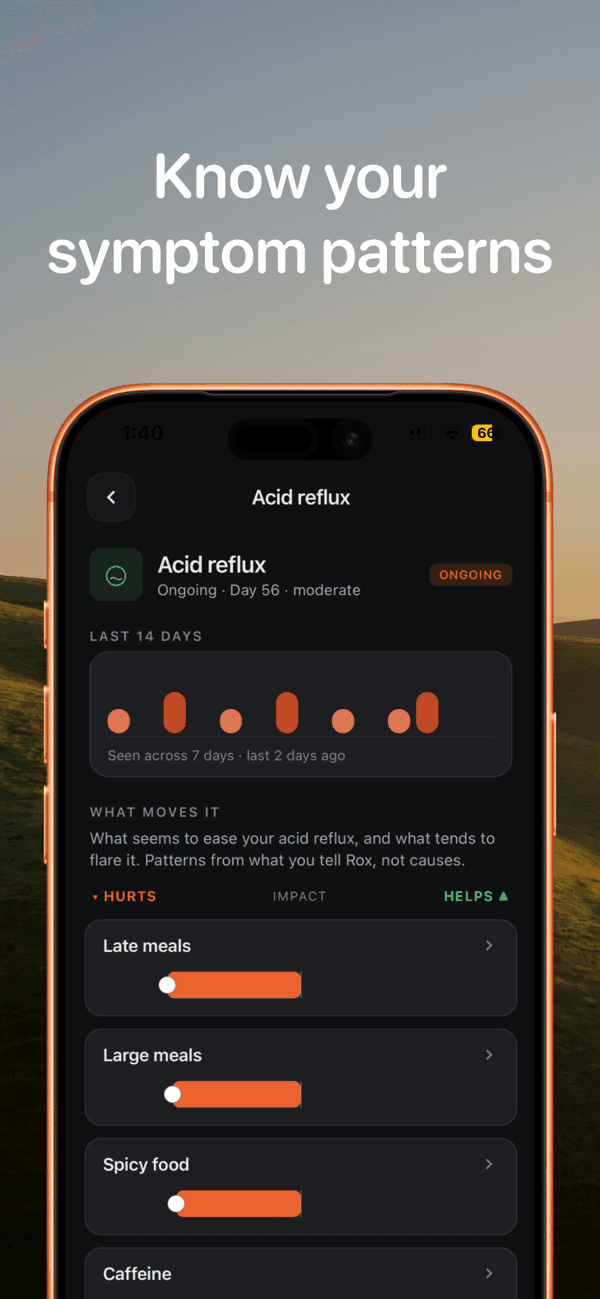
The insights are free. Logging is only useful if it tells you something. In Bearable, the advanced insights that connect the dots sit behind Bearable Premium. In Rox, those pattern insights are free.
The doctor report is free. Rox turns your logged history into a clear, doctor-ready report you can take to an appointment, with no subscription.
It’s built for overlapping conditions. Rox is designed for people whose health isn’t one tidy diagnosis, where POTS overlaps with fatigue, or perimenopause sits on top of a chronic condition.
The one thing you pay for in Rox is the AI features. Everything above is free.
Which should you choose?
Choose Bearable if you want a highly customizable daily tracker and don’t mind paying for the deeper correlation analysis.
Choose Rox if you want the insights and a doctor report without a subscription, and you’re managing complex or overlapping symptoms.
If you’re already logging in Bearable and hitting the paywall every time you want to understand why a symptom is flaring, Rox is worth a look. You can try Rox free on the App Store.
If neither of these two is quite right for you, there are other Bearable alternatives worth weighing, including free-tier trackers and record-syncing tools.
Frequently asked questions
Is Bearable free?
Bearable’s logging is free, including symptoms, mood, medications, and factors. Its advanced insights and correlations require Bearable Premium, which is around $35 a year (often discounted).
Is Rox free?
Yes. Symptom logging, medication logging, health vitals, insights from your logs, and the doctor report are all free. Only the AI features are paid.
What does Rox do that Bearable doesn’t?
Rox gives you pattern insights and a doctor-ready report for free, where Bearable charges for the deeper insights. Rox is also built specifically for complex, overlapping conditions.
Track it yourself: the free symptom tracker, mood tracker and medication tracker all run in your browser with no sign-up, and your data stays on your device. See all chronic illness trackers.